Reproductive Health Connection Hub
Oregon community health centers are well positioned to support patients across a range of reproductive health needs, including healthy relationships, family planning, contraception, and perinatal health. This page highlights key resources and OPCA initiatives related to reproductive health. To connect with fellow community health center professionals and exchange resources about this topic, please register for the group listserv.
Resources
Free Quality Improvement Support to Strengthen Contraceptive Care and Family Planning Services
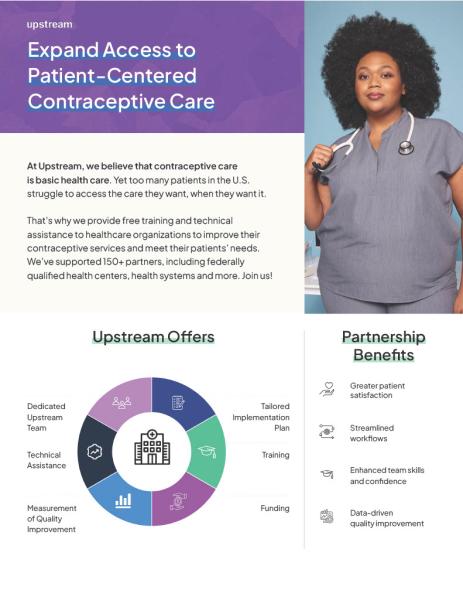
OPCA and Upstream USA are partnering to help Oregon community health centers strengthen contraceptive care and family planning services. Participating health centers receive free training, technical assistance, workflow support, and implementation funding to expand access to high-quality, patient-centered care. Upstream also helps health centers streamline UDS reporting by embedding standardized family planning screening tools into EHR workflows, supporting HRSA reporting requirements.
NEW – 24/7 OB Addiction Advice Line (Oregon)
Oregon healthcare staff involved in obstetric and addiction-related care can access free, 24/7 phone consultation with an addiction medicine physician. The service supports clinicians across hospital, outpatient, and specialty addiction treatment settings with questions related to opioid withdrawal, medications for substance use during the peripartum period, complex buprenorphine inductions, and other addiction-related concerns.
Call OHSU’s Physician Advice and Referral Service at 503-494-4567 and ask for the OB Addiction Advice Line; callers can expect a return call within one hour. Learn more.
UCSF’s Reproductive Health Hotline
Staffed by UCSF board-certified OB/Gyn and Family Physicians with specialized expertise in sexual and reproductive health (SRH), ReproHH is a hotline that provides clinical information to all U.S.-based healthcare providers, regardless of experience level. ReproHH is a free, confidential service for real-time, evidence-informed guidance on contraception, miscarriage management, abortion management, pregnancy management, sexually transmitted infections, menopause, and other reproductive health topics.
Whether you have a quick clinical question or are working through a complex patient scenario, call 1-844-ReproHH (844-737-7644) from Monday through Friday, 7 am-4 pm PT. Learn more.
Training and Continuing Education
WEBINAR: Foundations of Contraceptive Care (presented by Upstream USA)
Learners will leave this training with a stronger understanding of why contraceptive care is basic healthcare, the historical and current barriers patients face in accessing it, and how to offer contraceptive services in a way that centers each patient’s unique reproductive goals, needs, and preferences.
- Format: 1 hour, self-paced eLearning (four 15-minute lessons)
- Credits: 1.0 CE/CME
- Best for: Any clinical or administrative staff member looking to elevate the patient experience and enhance care delivery
ONLINE TRAINING: ASAM Treatment of OUD for Pregnant Patients (courtesy of the Oregon Perinatal Collaborative)
Learn to identify, assess, diagnose, and manage pregnant and postpartum patients with opioid use disorder (OUD). This 8-hour, online course from the American Society of Addiction Medicine (ASAM) covers medications for OUD and education needed to prescribe or dispense.
- Format: 8 hour, asynchronous
- Credits: Qualifies for CME & meets DEA 8hr training requirement on management of substance use disorders
- Best for: Physicians, Pediatricians, Neonatologists, Nurse Practitioners, Physician Associates, Clinical Nurse Specialists, Certified Registered Nurse Anesthetists, Students, and Certified Nurse Midwives seeking to treat opioid use disorder and prescribe buprenorphine in an office-based setting. All members of the healthcare team are encouraged to take the course.
OPCA proudly partners with: