
For Immediate Release
Oregon Congresswomen Bonamici and Dexter Support Community Health Centers and Patients Amid Federal Funding Uncertainty
Congresswomen Suzanne Bonamici and Maxine Dexter hosted a press conference at Healthcare Nonprofit Outside In to Inform the Public about the Potential Impact of a Federal Funding Freeze on Population Health
January 30, 2025
Portland, Oregon – President Trump’s Office of Budget Management (OMB) January 28 announcement of a temporary federal funding freeze left community health center (CHC) patients and providers scrambling to adjust their budgets and plan potential shutdowns of health services. Congresswomen Suzanne Bonamici and Maxine Dexter visited Portland-based CHC Outside In to speak with journalists about the local impacts of the OMB announcement.
“In response to the OMB memo, community health centers around the state immediately froze hiring and paused capital projects and investment plans,” said Oregon Primary Care Association (OPCA) Governmental Affairs Director Marty Carty. “They left vital positions unfilled, paused equipment and infrastructure upgrades, and limited their future capacity to expand access to health care services. Even after a federal judge stayed the order, FQHCs and their staff now live in a world of new uncertainty and fears.”
“It’s been a whirlwind of a situation in the last few days,” said Outside In Interim Co-Executive Director Iris Martin. Her finance team struggled to access monthly allotted Medicaid dollars in the hours after the announcement. Other Outside In staff worried about whether the organization could remain open beyond the next several weeks with little organizational cash on hand.
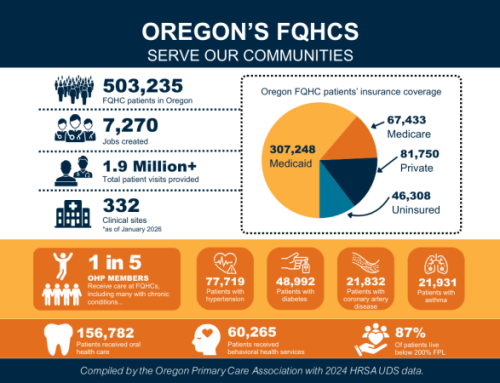
In Oregon, the state’s 34 community health centers combined serve more than 471,000 patients (roughly 1 in 10 Oregonians). These organizations rely on federal funding to deliver efficient and effective primary, dental, and behavioral healthcare services. Additionally, 61% of community health center patients in Oregon are enrolled in Medicaid while 11% are enrolled in Medicare.
Congressional District 1 Representative Suzanne Bonamici shared that her constituents have been vocal about the health effects of the freeze. “A mother who has an adult son with disabilities contacted our office and said her son would die if he did not have Medicaid. This is unacceptable,” the Congresswoman said. “I want to be clear: the president does not have the power to block funding that Congress has already directed and appropriated. This planned freeze threatened lots of programs – programs that feed infants and new mothers, programs that help people pay their heating bills, provide affordable child care, and cover health care.”
“It is without question we have to stand firm, together, and press on with the stories and the information that everyone has. The fact that Iris has the ability to communicate quickly with other FQHCs is critical so that everyone understands how we’re going to stand fast and move forward together,” said Congressional District 3 Representative Maxine Dexter, MD. “What is cruel and uncertain is going to make us stronger. We must stand firm together.”
Congresswoman Dexter also encouraged people to share their stories and recount what’s happening as a result of the funding freeze. “We can’t do our job without the information from this community,” she said.
###
About us
The Oregon Primary Care Association (OPCA) is a nonprofit membership organization for the state’s federally qualified health centers (FQHCs) and look-alikes. OPCA members deliver integrated medical, dental, and behavioral health services to vulnerable communities. OPCA generates data-driven insights into members’ operational challenges, provides best-practices training, and shapes evolving policy to achieve health equity in Oregon and beyond.
Related Posts